INTRODUCTION:
If you’re replacing an aging air conditioner or adding cooling to a space that doesn’t have it you’re facing one of the most common and most confusing decisions in home comfort — mini split or central AC?
Both systems cool your home effectively. Both have legitimate advantages depending on your situation. And both have passionate advocates who will tell you their preferred system is clearly superior.
The truth is neither system is universally better. The right choice depends entirely on your home’s specific characteristics — its size, layout, existing infrastructure, budget, and your long term comfort goals.
This complete comparison breaks down every important difference between mini split and central AC systems so you can make an informed decision based on facts rather than marketing claims.
H2: What Is a Mini Split System?
A mini split — also called a ductless mini split or ductless heat pump — is a two component cooling and heating system consisting of an outdoor compressor unit and one or more indoor air handling units mounted on walls, ceilings, or floors.
The two components are connected by a small bundle of refrigerant lines, electrical wiring, and a condensate drain line that runs through a small hole in the wall — typically 3 inches in diameter. No ductwork is required.
Each indoor unit operates independently and conditions only the space it’s installed in. A single outdoor unit can connect to multiple indoor units — called a multi-zone system — allowing independent temperature control in several rooms simultaneously.
Mini splits were developed in Japan in the 1950s and have been the dominant cooling technology in Asia and Europe for decades. They’ve gained significant market share in the United States over the past 15 years as energy efficiency standards have tightened and installation costs have declined.
H2: What Is Central AC?
A central air conditioning system uses a network of ducts to distribute cooled air throughout your entire home from a single central unit. The system consists of an outdoor condenser unit, an indoor air handler or furnace with an evaporator coil, and a duct system that carries conditioned air to every room through supply vents and returns air through return vents.
Central AC conditions your entire home simultaneously to a single temperature set by one thermostat — or multiple temperatures in systems with zone controls. It’s the dominant cooling technology in American homes with approximately 90 percent of new construction using central forced air systems.
Central AC typically uses your existing furnace blower and ductwork — meaning it integrates seamlessly with your existing heating system and doesn’t require any new wall penetrations or mounted hardware in your living spaces.
H2: Mini Split vs Central AC — Cost Comparison
Cost is usually the first consideration and the comparison is more nuanced than most people expect.
Mini Split Costs:
A single zone mini split system — one outdoor unit and one indoor unit — costs $700 to $2,000 for the equipment alone. Professional installation adds $500 to $2,000 depending on complexity and local labor rates.
Total installed cost for a single zone system typically ranges from $1,500 to $4,500.
Multi zone systems — one outdoor unit serving 2 to 5 indoor units — cost significantly more. Equipment costs range from $2,000 to $7,000 and installation can add another $3,000 to $8,000 for a multi-zone whole-home system.
Total installed cost for a whole-home multi-zone mini split system ranges from $5,000 to $15,000 or more depending on the number of zones and home complexity.
Central AC Costs:
A central AC system replacement — new outdoor condenser, new coil, and connecting refrigerant lines — costs $3,000 to $7,000 installed for most homes. This assumes existing ductwork is in acceptable condition and the furnace blower is compatible.
If ductwork needs significant repairs or replacement add $1,500 to $5,000 for duct work.
If no ductwork exists and must be installed from scratch add $5,000 to $10,000 for complete duct system installation.
Total installed cost for central AC in a home with existing compatible ductwork: $3,000 to $7,000. Total installed cost for central AC in a home requiring new ductwork: $8,000 to $17,000.
Cost Verdict: For homes with existing ductwork central AC is almost always less expensive to install than a whole-home mini split system. For homes without ductwork the comparison is much closer — and mini splits often win on total installation cost when ductwork installation is factored in.
H2: Energy Efficiency Comparison
Energy efficiency is where mini splits have a clear and significant advantage over most central AC systems.
Mini Split Efficiency: Mini splits are rated using SEER2 — Seasonal Energy Efficiency Ratio — a measure of cooling output relative to energy input. Modern mini splits typically achieve SEER2 ratings of 18 to 30 or higher. The absence of ductwork eliminates the 20 to 30 percent energy loss that occurs in typical central AC duct systems.
The most efficient mini splits — inverter driven variable speed compressors — adjust their output continuously to match your home’s cooling demand rather than running full blast and cycling off. This precision operation dramatically reduces energy consumption compared to single stage central AC systems.
Central AC Efficiency: Modern central AC systems achieve SEER2 ratings of 14 to 22. However that rated efficiency is measured under ideal laboratory conditions. In real world operation duct losses reduce effective efficiency by 20 to 30 percent — meaning a central AC rated at SEER2 18 may deliver real-world performance equivalent to SEER2 13 or 14.
Higher efficiency central AC systems with two-stage or variable speed compressors close the gap with mini splits — but typically cost $2,000 to $4,000 more than basic single stage units.
Efficiency Verdict: Mini splits are significantly more energy efficient in real world operation — especially in homes with leaky ductwork. A homeowner switching from an older central AC to a high efficiency mini split system can expect 25 to 40 percent reductions in cooling energy costs. For central AC to match mini split efficiency it requires both high efficiency equipment and well sealed, well insulated ductwork.
H2: Installation Comparison
Installation complexity and disruption is a significant practical consideration that affects both cost and the decision of which system is right for your situation.
Mini Split Installation: Installing a mini split requires mounting the indoor unit on a wall or ceiling, mounting the outdoor unit on a pad or wall bracket, running the refrigerant line set and electrical wiring through a 3-inch hole in the wall between the indoor and outdoor units, and charging the system with refrigerant.
The process is minimally invasive — no ductwork, no attic or crawl space work in most cases, and no major wall or ceiling penetrations. Most single zone installations are completed in one day.
DIY mini split installation is technically possible and some homeowners do install pre-charged line set systems themselves — but refrigerant work requires EPA 608 certification and most manufacturers require professional installation to maintain warranty coverage.
Central AC Installation: Installing central AC requires connecting the outdoor condenser to the indoor air handler via refrigerant lines, connecting to the existing duct system, and integrating with the thermostat and electrical system.
In homes with existing compatible ductwork central AC installation is straightforward and typically completed in one day. In homes requiring new or extensively modified ductwork installation is significantly more disruptive — involving attic work, crawl space access, cutting through walls and ceilings, and potentially several days of work.
Installation Verdict: For homes with existing ductwork central AC installation is simpler and less expensive. For homes without ductwork mini splits are significantly simpler to install — avoiding the major disruption and cost of new duct system installation.
H2: Comfort and Temperature Control Comparison
Mini Split Comfort: Mini splits excel at precision comfort control. Each indoor unit conditions only its zone — meaning the bedroom can be 68 degrees while the living room is 74 degrees simultaneously. Variable speed compressors maintain temperature within 0.5 to 1 degree of the set point — far more precise than most central AC systems.
The absence of ducts eliminates the temperature stratification that occurs in central AC systems — where air cools significantly between the air handler and the far end of a long duct run.
Mini splits also excel at dehumidification — removing moisture from the air is critical to summer comfort and mini splits’ variable speed operation allows them to run longer at lower capacity, extracting more humidity than single-stage central AC systems that cycle on and off rapidly.
Central AC Comfort: Central AC conditions your entire home simultaneously — convenient for open floor plans where you want consistent temperature throughout. A single thermostat controls the whole system — simpler to manage than multiple mini split remote controls or apps.
However central AC is less precise at temperature maintenance — single stage systems blast full cold air until the thermostat is satisfied then shut off completely, creating temperature swings of 2 to 4 degrees around the set point.
In homes with long duct runs or poor duct insulation significant temperature differences can exist between rooms — a common source of comfort complaints that central AC inherently struggles to address.
Comfort Verdict: Mini splits provide superior comfort — more precise temperature control, better dehumidification, and no duct related temperature inconsistencies. Central AC is more convenient for whole-home conditioning from a single control point.
H2: Heating Capability Comparison
This is one of the most important and most overlooked differences between the two systems — especially in climates that experience cold winters.
Mini Split Heating: Most mini splits are heat pumps — they provide both cooling and heating using the same equipment. Modern inverter-driven mini split heat pumps operate efficiently down to outdoor temperatures of 5°F to -13°F depending on the model — making them viable heating sources in all but the most extreme cold climates.
The heating efficiency of mini split heat pumps — measured as Heating Seasonal Performance Factor or HSPF — is typically 2 to 3 times more efficient than electric resistance heating and comparable to or better than gas heating in moderate climates.
For homeowners in mild to moderate climates a mini split heat pump can completely replace both the air conditioner and the furnace — providing year round comfort from a single system.
Central AC Heating: Standard central AC provides cooling only — no heating. It integrates with your existing furnace for heating. In homes with gas furnaces this is perfectly adequate — the furnace handles heating and the central AC handles cooling using the same ductwork.
Central AC with heat pump capability — called a central heat pump — is available and provides similar heating efficiency benefits to mini split heat pumps. However central heat pumps still rely on ductwork — maintaining the duct efficiency disadvantages of central AC systems.
Heating Verdict: For homeowners replacing both heating and cooling equipment simultaneously a mini split heat pump offers significant advantages — replacing two systems with one, providing excellent efficiency, and eliminating duct losses year round. For homeowners with a functioning gas furnace who only need to replace cooling equipment central AC is the simpler and less expensive choice.
H2: Aesthetics and Space Considerations
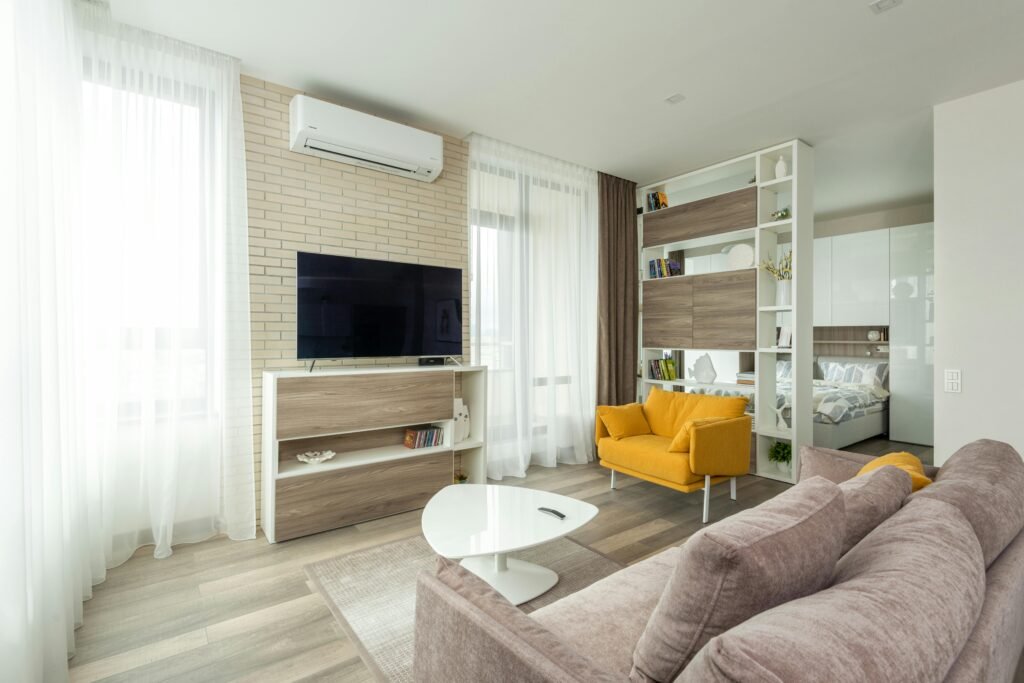
Mini Split Aesthetics: The indoor unit is visible in your living space — mounted on a wall, ceiling, or floor. Modern mini split indoor units are slim and relatively unobtrusive but they are a visible fixture that some homeowners find unattractive.
Wall mounted units are the most common and least expensive option. Ceiling cassette units are less visible — recessed into the ceiling with only a small grille showing. Floor mounted units work well in rooms with limited wall space.
The refrigerant line set running along the exterior of your home to connect indoor and outdoor units is also visible — typically covered with a line set cover that blends with your home’s exterior.
Central AC Aesthetics: Central AC is virtually invisible in your living space. The supply vents and return grilles are small and generally unobtrusive. All the mechanical components are hidden in the air handler and outdoor unit. No visible equipment in your rooms beyond the thermostat.
Aesthetics Verdict: Central AC wins on aesthetics — it’s effectively invisible in your living space. Mini splits require visible indoor units that some homeowners find intrusive. This is a significant consideration for homeowners with carefully designed interiors.
H2: Maintenance Comparison
Mini Split Maintenance: Mini splits require regular filter cleaning — mini split filters are washable and should be cleaned every 2 to 4 weeks during heavy use. Annual professional maintenance includes checking refrigerant levels, cleaning the indoor and outdoor coils, and verifying electrical connections.
The absence of ductwork eliminates duct cleaning, duct sealing, and duct related maintenance entirely.
Central AC Maintenance: Central AC requires regular filter replacement — typically every 60 to 90 days. Annual professional tune-ups cover the same items as mini split maintenance. Additionally ductwork requires periodic cleaning and inspection for leaks — tasks that add both time and cost to central AC ownership.
Maintenance Verdict: Both systems require similar levels of attention. Mini splits require more frequent filter cleaning but eliminate duct maintenance. Central AC filter replacement is less frequent but duct maintenance adds ongoing costs over the system’s lifetime.
H2: Which System Is Right for You?
Use this guide to make your decision:
Choose a mini split if: You don’t have existing ductwork and would need to install it for central AC. You’re adding cooling to a specific room or addition without connecting to your existing system. You want maximum energy efficiency and lower long term operating costs. You want precise independent temperature control in different rooms. You’re in a mild climate and want one system for both heating and cooling. You’re willing to accept visible indoor units in exchange for superior performance.
Choose central AC if: You have existing ductwork in good condition — this is the strongest argument for central AC. You want a whole-home solution controlled from a single thermostat. You prefer invisible HVAC equipment in your living spaces. You have a functioning gas furnace and only need to replace the cooling system. Your budget is limited — central AC in a home with existing ductwork is typically less expensive to install.
The hybrid approach: Some homeowners use central AC for main living areas and mini splits for specific problem rooms — a bedroom that never gets cool enough, a garage apartment, or a sunroom addition. This hybrid approach captures the advantages of both systems without the full cost of a whole-home mini split installation.
H2: Best Mini Split Brands for 2026
If you’ve decided a mini split is right for your situation here are the most reliable brands:
Mitsubishi Electric — The gold standard in mini splits. Known for exceptional reliability, whisper quiet operation, and industry leading cold weather heating performance. Expect to pay a premium — typically 20 to 30 percent more than comparable units from other brands.
Daikin — Another Japanese manufacturer with an excellent reliability record. Offers a wide range of models including high efficiency units with SEER2 ratings above 25. Good balance of performance and price.
LG — Reliable Korean brand with strong performance across their lineup. LG Art Cool models feature a more attractive indoor unit design that blends better with modern interiors.
Fujitsu — Particularly strong cold weather heating performance. Popular in northern climates where mini splits need to perform reliably in very cold temperatures.
Pioneer and Mr. Cool — Budget friendly options popular with homeowners who want to minimize upfront cost. Reliability is generally acceptable but not at the level of the premium Japanese brands.
H2: Best Central AC Brands for 2026
If central AC is your choice here are the most reliable brands:
Trane — Consistently rated among the most reliable central AC brands. Manufactures its own compressors — a quality control advantage over brands that use third party compressors. Premium pricing but strong longevity.
Carrier — The brand that invented modern air conditioning. Excellent reliability record with a wide range of efficiency options from basic to ultra high efficiency.
Lennox — Known for producing some of the highest SEER-rated central AC units available. The Dave Lennox Signature series regularly achieves SEER2 ratings above 20. Premium pricing justified by exceptional efficiency.
Rheem and Ruud — Same parent company, excellent value for money. Solid reliability at prices typically 15 to 20 percent below premium brands. Good choice for budget conscious buyers who don’t want to sacrifice quality.
Goodman — The most affordable major brand in central AC. Owned by Daikin. Reliability has improved significantly in recent years and Goodman offers a strong warranty — making it a legitimate option for price sensitive buyers.
H2: Frequently Asked Questions
Q: Can a mini split cool an entire house? Yes — a multi-zone mini split system with indoor units in each room or zone can cool an entire home. However the upfront cost for a whole-home multi-zone mini split system is typically higher than central AC in a home with existing ductwork. Multi-zone mini splits make the most economic sense in homes without existing ductwork.
Q: Are mini splits worth the extra cost? For homes without existing ductwork mini splits are almost always worth the investment — they avoid the cost and disruption of duct installation while providing superior efficiency. For homes with existing ductwork in good condition the ROI calculation is less clear — the efficiency advantage of a mini split may take 7 to 12 years to offset the higher installation cost.
Q: How long do mini splits last compared to central AC? Both systems have similar lifespans of 15 to 20 years with proper maintenance. Mini splits may have a slight longevity advantage due to variable speed compressor operation — running at lower speeds more continuously puts less stress on the compressor than the repeated start stop cycles of single stage central AC.
Q: Do mini splits work in cold climates? Modern cold climate mini split heat pumps operate efficiently down to -13°F. Brands like Mitsubishi Hyper Heat and Fujitsu Halcyon are specifically designed for cold climate performance. For most of the continental United States a quality mini split heat pump provides adequate heating without backup heat. In extremely cold climates a backup electric resistance heater may be needed for the coldest days.
Q: Can I install a mini split myself? Some mini splits — particularly pre-charged line set systems like Mr. Cool DIY — are designed for homeowner installation. However most manufacturers require professional installation for warranty coverage and refrigerant work requires EPA 608 certification. A DIY installation may void your warranty and could result in substandard performance if not done correctly.
Q: What size mini split do I need? Mini split sizing is based on BTU capacity — the amount of heat the system can remove per hour. A rough rule of thumb is 20 BTU per square foot of space — so a 500 square foot room needs approximately 10,000 BTU and a 1,000 square foot open area needs approximately 20,000 BTU. Factors including ceiling height, insulation quality, sun exposure, and local climate affect the precise sizing needed. A Manual J load calculation performed by a licensed HVAC contractor provides the most accurate sizing.